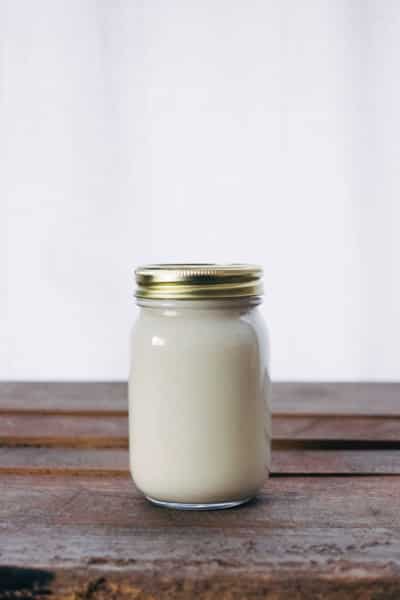
Make Real Cultured Buttermilk
Real cultured buttermilk can be just as easy if not easier to make and keep on hand and have when you need it as making soured milk would ever be in a pinch. All you need are two ingredients to make at least a quart plus about 30 seconds of your time to feed the culture at least once a week. As long as you can do that, you will never run out of fresh cultured buttermilk. According to the St. Louis Dairy Council, cultured buttermilk will keep in your refrigerator for about two weeks.
The best choice for making buttermilk the first time is to purchase an heirloom culture that will reculture from one batch to the next.
Your second choice could be to pick up a carton of cultured buttermilk from the store to use as a starter.
I know the second choice actually sounds like the easier choice, but how well your buttermilk will reculture time after time will depend upon the quality of the carton of cultured buttermilk that you bought to make your first batch.
After making your first batch, you'll need to feed the cultures at least weekly to keep the cultures active. The longer you go beyond seven days and don't feed your culture, the less likely it will be that your new batch of buttermilk will turn out the way you want it.
To feed your buttermilk cultures, you'll need to add 1/4 cup cultured buttermilk from your previous batch to a quart of any skim, 1%, 2%, or whole milk for each quart you plan to make. You'll also need a quart or half-gallon jar with a tight-fitting lid. Then let it sit loosely covered at room temperature on the back of the counter for 12 to 24 hours, preferably out of direct sunlight. The perfect temperature range to do this job is about 70 to 80 degrees.
I know some recipes will tell you that you have to use fresh, raw milk to make your buttermilk. That is just not the case. Other recipes will tell you you need to raise the temperature of the milk to 180 degrees before making the buttermilk. That would be what you need to do to pasteurize raw milk, so unless you are using raw milk, that step is unnecessary. The milk you purchase from the store already went through the pasteurization process. Finally, I've noticed several recipes that tell you to stay away from ultra-pasteurized milk. All I can say is good luck, and mine turns out just fine.
Is It Safe To Leave Milk Out
As for safety, you will have to be the judge of that for yourself. I am in no way recommending you do anything you feel to be unsafe. What I am telling you, I've been doing this my whole life and never once had a problem.
In America, we're all taught to fear any food item that has remained at room temperature for more than 8.7 seconds. Well, maybe not quite that bad, but I hope you see my point because the truth is people have been safely fermenting and culturing food around the world for thousands of years.
To make cultured buttermilk, you must add bacteria and allow milk to ferment and culture. If you don't, you cannot make cultured buttermilk, period. It's just that simple. Whether some company cultures and ferments ten-thousand gallons at a time or you, in your home, culture and ferment a few quarts is irrelevant. What matters is that you do it in a manner that is as safe as possible.
When you pasteurize raw milk, you're killing bacteria in the milk. The pasteurization process is not selective, so you're killing both beneficial and non-beneficial bacteria. When you re-introduce beneficial bacteria found in cultured buttermilk and allow the milk to ferment and culture at room temperature, the bacteria feed on the natural sugars found in the milk. Sugar turns into lactic acid, which in turn helps to protect the cultured milk from other bacteria.
What Are Some Things I Can Make With Homemade Buttermilk
You'll want to bookmark this page and check back here from time to time because the list is pretty much endless. Each time we add a recipe that uses cultured buttermilk, we'll update this article with a link to the recipe.
Here are just a few to get you started:
Buttermilk Pancakes
Waffles
Buttermilk Biscuits
Muffins
Buttermilk Cornbread
Marinades
Ranch Dressing
Tenderizing Meat
Créme Fraiche (French Style Sour Cream)